
The digital world is experiencing a major transformation. Until now, artificial intelligence (AI) and blockchain technology have developed separately; blockchains act as secure financial records, while AI run inside centralized data centers processing large datasets privately. But by 2026, the need for trustworthy, decentralized AI has sparked a new model called the AI-native blockchain, or “Blockchain 5.0.” Unlike the traditional AI, this new generation of AI-native blockchain has already been injected into the blockchain’s core functions.
This change is happening fast; it is going from something we just talk about to something we actually use because people need to make sure AI is safe and they can make money from it all around the world. This guide tells us what AI-native blockchains are, how AI-native blockchains work, and what AI-native blockchains can do to change the way we do things online with money. It’s designed to help Web3 developers, investors, and institutions understand how decentralized intelligence can reduce centralized control and create new autonomous applications.
What Is an AI-Native Blockchain?

To fully grasp the magnitude of the AI-native blockchain, one must first recognize the fundamental limitations of legacy Web3 infrastructure. To really get why AI-native blockchains matter, you need to understand the limits of traditional Web3 systems. Regular blockchains work with fixed, clear rules. For example: If User A sends 10 tokens to Contract B, then release Asset C. This works well for secure transactions, but it doesn’t fit with machine learning, which is all about probabilities and predictions, not simple yes-or-no answers. So, an AI-native blockchain is important for the future of the blockchain.
An AI-native blockchain completely redesigns network architecture to execute, verify, and utilize machine learning logic natively. Instead of merely transferring tokens to pay for remote server time on a centralized cloud provider like AWS or Google Cloud, the blockchain ledger itself possesses computational awareness of the AI tasks it facilitates. This is a huge step forward for smart, self-running, and flexible decentralized systems. In an AI-native network, intelligence isn’t just an extra feature; it’s the main tool that protects the network and benefits everyone involved.
The Shift from AI-Enabled to AI-Native
The distinction between an “AI-enabled” application and an “AI-native” infrastructure is a critical dividing line for developers and architects:
- AI-Enabled: Consider a decentralized exchange (DEX) running a standard smart contract on Ethereum. The developers decide to add a customer support chatbot to the frontend interface. This chatbot is powered by a centralized language model hosted off-chain. The blockchain ledger is entirely blind to the AI’s existence; it only records the financial transactions that result from the user’s interaction.
- AI-Native: A specialized blockchain network is designed from the ground up so that its validator nodes are actively engaged in training AI models, routing inference requests, or cryptographically verifying the outputs of machine learning computations. The AI’s logic, parameters, and verification proofs are anchored directly into the blockchain’s state.
By decentralizing the computation, data storage, and verification required for artificial intelligence, these networks aim to create an open, censorship-resistant market for intelligence. They prevent the monopolization of machine learning by a handful of centralized tech giants while introducing mathematical trust to AI outputs.
Also Read: What Is Agentic AI? A Complete Guide to the Future of Automation
What Are the Core Features of AI-Native Blockchains?
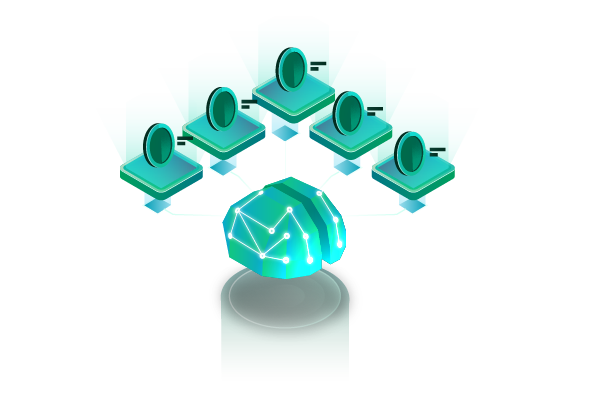
Running modern neural networks requires computational power that severely outstrips the capabilities of standard blockchain nodes. To solve this, the architecture of an AI-native blockchain relies on extreme modularity and decoupling complex functionalities like identity, policy, payments, and custody into flexible blocks that autonomous agents can interact with seamlessly.
1. The Execution Layer: TEEs and ZKML
The process of a trained model generating an output based on new data must be both fast and verifiable. Because smart contracts cannot safely run large AI models directly on-chain due to exorbitant gas costs and determinism limits, the most viable architecture is off-chain inference paired with on-chain verification. AI-native blockchains utilize two primary approaches for this execution layer:
- Trusted Execution Environments (TEEs): Secure hardware areas where AI models run. A sequencer handles the AI task inside this protected space and creates a cryptographic proof showing the exact, unaltered program completed the work. This allows for inference processing in fractions of a second, balancing high speed with verifiable hardware integrity.
- Zero-Knowledge Machine Learning (ZKML): For networks prioritizing absolute cryptographic certainty over hardware trust assumptions, ZKML allows an off-chain computational node to process an AI task and generate a zero-knowledge proof. This proof verifies that a specific model was run on specific data correctly, without revealing the underlying private data or the model’s proprietary weights. The blockchain directly checks this small proof, which is becoming essential for important financial systems and healthcare services.
2. The Data Availability (DA) Layer
AI agents need continuous, fast access to large volumes of external data and past blockchain records. Standard legacy blockchains process too little data per second to feed hungry AI models. Modern AI-native networks utilize specialized Data Availability layers that separate data publishing from execution and long-term storage. By leveraging parallel data processing and advanced erasure coding, these DA layers ensure that the datasets required for AI inference are permanently accessible and mathematically verifiable without congesting the core consensus ledger.
3. AI-Driven Consensus Mechanisms
Perhaps the most radical architectural shift is the introduction of consensus protocols that secure the blockchain by leveraging productive artificial intelligence workloads. Instead of wasting electricity solving arbitrary cryptographic puzzles (Proof of Work), new frameworks utilize execution verification models. For instance, a network protocol can use numerical confidence scores (logits) generated by language models as a unique computational fingerprint. Validators randomly check certain token positions to confirm that a miner completed the necessary machine learning work, helping secure the network while also creating valuable AI results.
Comparison of Traditional vs. AI-Native Blockchain
To differentiate the two types of blockchain, this table below will describe the comparison between traditional and AI-native blockchains.
Table 1. Comparison Between Traditional and AI-Native Blockchain
| Feature | Traditional Blockchain | AI-Native Blockchain |
| Core Function | Deterministic financial ledgers and basic logic. | Probabilistic machine learning and verifiable intelligence. |
| Node Hardware | Standard consumer CPUs and basic server racks. | Institutional-grade GPUs and massive RAM clusters. |
| Consensus Mechanism | Proof of Work (PoW) or standard Proof of Stake. | Proof of Utility, cryptographic proofs, or execution verification. |
| Execution Environment | On-chain Virtual Machines | Off-chain TEEs, ZKML circuits, and agent protocols. |
| Data Handling | Kilobytes per second; constrained block sizes. | Modular DA layers utilizing erasure coding for high throughput. |
| Primary Use Cases | Token transfers, basic NFTs, simple DeFi swaps. | Autonomous AI agents, compute markets, automated risk scoring. |
Also Read: Top 10 AI-Powered Blockchain Tools To Choose in This Year
What Are the Risks and Challenges of AI-Native Blockchain?
AI-native blockchains essentially have a lot of potential and benefits for people that use them. On the other hands, this system also has the weaknesses that you should look at to help you mitigate the bad occurrences
- The Hardware Centralization Trap: Running modern machine learning models requires institutional-grade GPUs and immense RAM clusters. This hardware requirement naturally restricts validator status to well-funded data centers and enterprise consortiums. This creates a clear risk of geographic and political centralization that cuts against traditional Web3 philosophy. If only a few entities can afford to verify the network, it becomes vulnerable to regulatory capture.
- Security Risks of Agentic Wallets: AI agents can autonomously do anything they want; they also have wallets to help them to do transactions. This wallet may have the security problem. For example: draining funds or approving the fraudulent transactions. To mitigate this from happening, you need to choose suitable hardware security and limit the spending for a certain amount of capital.
- Hallucination: Artificial intelligence models work based on probabilities and can sometimes produce incorrect or made-up information. In a smart contract system without proper safeguards, a single mistake from an AI agent can set off a chain reaction of permanent, incorrect transactions on the blockchain. This can result in irreversible loss of assets. To prevent this, safety measures called circuit breakers need to be built directly into the system’s core.
- Subjective Consensus Dilemmas: Blockchains rely on absolute mathematical agreement across thousands of nodes. Machine learning outputs are inherently variable and non-deterministic. Aligning a network of nodes to agree on whether a specific probabilistic AI output is correct requires complex, multi-layered verification protocols that introduce structural overhead and latency to the network.
What Are the Benefits of AI-Native Blockchain?

Moving from traditional blockchain to AI-native blockchains brings major benefits for developers, businesses, and regular users. By embedding machine learning at the heart of the network, these systems fix ongoing problems and open up completely new ways to create value and run businesses.
- Verifiable Data Integrity and Trustless AI: A major challenge in AI today is ensuring decisions aren’t tampered with and data stays trustworthy. AI-native blockchains ensure the data used in machine learning is securely verified and cannot be changed. When an AI model runs on the blockchain, it generates a trustworthy, math-based record that details the data and steps involved.
- Radical Operational Efficiency and Automation: Traditional smart contracts are fixed and only run when exact conditions are met. AI-native systems bring flexible smart contracts that can adjust to changing, real-time situations based on probabilities. AI algorithms embedded in the network can monitor network congestion, actively optimize gas fees, or automatically negotiate the most sustainable supply chain routes instantly.
- Broader Access to Computing Power and Reduced the Cost: Training the AI models usually needs centralized data centers that institutional companies and big firms can afford. AI-native blockchains facilitate open, decentralized computing markets (DePIN). In the decentralized system, people can get the profit through earning a token by sharing the unused power in the GPU; this indicates that the cost will be more affordable than a centralized network.
- Enhanced Security and Anomaly Detection: AI-native networks use machine learning to continuously monitor and assess risks. They quickly spot security issues or anomalies in the system.
Also Read: AI Agent Architecture: Components, Patterns, and How It Works
How to Deploy AI-Native Blockchain?
If you are a Web3 developer or a network architect who wants to build on or move to an AI-native blockchain infrastructure, you need to do things carefully. You have to manage the logic that happens on the blockchain and the models that happen outside of the blockchain at the time.
The following sequence is what you need to do to deploy an AI- application
Step 1: Define the Workload and Hardware Requirements
Assess whether your application requires decentralized model training or merely decentralized inference. Select an AI-native protocol that caters to your specific computational requirements and hardware availability.
Step 2: Select the Verification Architecture
Decide how your AI’s output will be cryptographically proven to the network. If your application requires high-speed, sub-second finality, configure a Trusted Execution Environment. If you require absolute cryptographic security without hardware trust assumptions, compile your model into a Zero-Knowledge circuit, keeping in mind the increased computational overhead.
Step 3: Integrate the Data Availability (DA) Layer
Do not push raw AI inputs or large training datasets directly to the execution layer. Connect your application to a modular Data Availability network to publish your transaction data securely. This ensures your AI agents have constant, cheap access to historical state data without congesting the core consensus ledger.
Step 4: Deploy the Anchor Smart Contract
Deploy a standard smart contract on the base layer that acts as the financial and permissions anchor. This contract should contain the rules for token escrow, the cryptographic keys required to verify the AI’s proofs (either TEE attestations or ZK-proofs), and the strict logic to execute value transfers only when a valid, verifiable proof is received.
Step 5: Initialize the Autonomous Agent
Launch your AI agent off-chain or within the network’s specialized compute subnet. Grant the agent secure API access to read the blockchain’s state and broadcast signed transactions back to your anchor smart contract. Ensure the agent’s spending authority and action space are strictly bounded by the permissions defined in the previous step.
Step 6: Monitor the Dispute Window
If your chosen network utilizes Optimistic Machine Learning (opML), actively monitor the mandatory dispute window. Ensure your systems are prepared to replay computations deterministically if an honest verifier challenges the agent’s output before the transaction achieves finality on the ledger.
Conclusion
The evolution toward the AI-native blockchain represents one of the most significant architectural upgrades in the history of digital infrastructure. By transitioning from passive financial ledgers to active, intelligent networks built on composable primitives, Web3 is solving one of the greatest challenges of the AI era: the need for verifiable, decentralized, and auditable machine learning.
As we progress deeper into 2026, the success of these networks will not be measured by speculative token prices but by their measurable utility. Whether it is autonomous agents managing institutional treasuries, decentralized physical infrastructure networks democratizing access to GPU compute, or strict compliance layers enforcing the rules of AI-driven finance, the AI-native blockchain is forging a new standard for the digital economy. The organizations and developers who master the balance of probabilistic intelligence and deterministic control will be the ones who define the next decade of technological innovation.
Frequently Asked Questions

Tegar Rahman Hidayah is an SEO content writer specializing in technology and financial markets, with a strong emphasis on blockchain, cryptocurrency, and fintech. Passionate about bridging innovation and understanding, he aims to make advanced concepts more approachable through clear and informative storytelling. His work frequently explores emerging trends in web3, blockchain, and data-driven technologies, helping readers navigate the rapidly evolving landscape of modern finance.