
The paradigm of how artificial intelligence (AI) works is beginning to shift into something new. AI is not only a reliable chatbot that just answers your question; it can be a system that can do more complex tasks now. Agentic AI or AI Agent is a term that people use to describe AI as an autonomous system that is not only capable of doing simple work but also has the goal to do harder and more complex work. Although it can do complex work, the process of doing the task could become ineffective if the project that has been assigned is very complex and beyond the capabilities of only one AI agent. To solve that problem, multi-agent systems emerge as a solution. If you are trying to figure out and ask: what is a multi-agent system in AI? This article will help you.
In this guide, we will break down the mechanics, architectures, and real-world applications of multi-agent systems, exploring how dividing complex tasks among specialized digital workers helps humans maximize their task.
What Is a Multi-Agent System in AI?
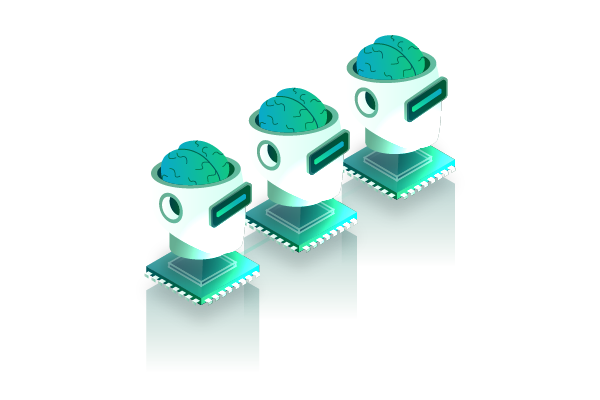
A multi-agent system in AI is a group of autonomous AI agents who collaborate collectively to do certain complex jobs. This type of system is often utilized by enterprise-grade environments. Many firms have been using this to help them build an automated system that benefits the company’s effective workflows.
These AI agents have been given their respective different instructions to help solve the problems. Those AI agents also have their own role. For example, a software development company uses this system to complete a project. They have four agents working on it:
- The product manager agent
- The system architect agent
- The engineer agent
- The QA tester agent
These agents work together to help the company reach its goal. The product manager agent, system architect agent, engineer agent, and QA tester agent all play a role. They collaborate to achieve the goal.
How Is the Workflow of Multi-Agent System in AI?
The complex goal of problem-solving on an enterprise scale needs an effective workflow of a multi-agent system. It relies on the automated system that blends in AI and software technology. For example, a company wants to write a comprehensive, data-backed market research report on the electric vehicle industry.
If you use a single-agent system, you ask it to write the report, and it spits out 1,000 words based on whatever it remembers from its training data. It might be okay, but it probably lacks deep, current insights.
Here is how a multi-agent system handles that exact same request:
Step 1: The Request
The first step is requesting the system by submitting the prompt.
Step 2: Task Delegation
A Manager Agent reads your prompt. Then it breaks it down into an outline.
Step 3: Research Phase
The Manager wakes up the Research Agent and tells it to find the latest sales numbers for electric vehicles in 2026. The Research Agent uses its web search tools, gathers the data, and saves it to the shared environment.
Step 4: Drafting Phase
The Manager then tags in the Writer Agent. The Writer Agent reads the data the Researcher found and writes a draft of the report.
Step 5: Quality Assurance
Once drafted, the text is automatically sent to a Reviewer Agent. The Reviewer’s only job is to check the draft against the original prompt. It notices that the Writer forgot to mention European markets.
Step 6: Iteration
The Reviewer kicks the draft back to the Writer with a note for revision. The Writer fixes it.
Step 7: Final Output
The Manager Agent confirms everything is done and presents the final, polished report to you.
You didn’t have to manage any of this. You just gave the initial instruction, and the digital team collaborated to get it done.
Also Read: Top 10 AI dApps Blockchain Platforms to Consider in This Year
What Are the Core Features of Multi-Agent System in AI?
You can’t just throw five chatbots into a chatroom and expect them to build a software application. For a multi-agent system to actually work, it needs structure. Every functional multi-agent system is built on three core pillars.
1. The Autonomous Agents
The agents are the actual entities doing the heavy lifting. The autonomous agent acts as a worker of multi-agent system in AI. Powered by underlying LLMs, these agents are given a highly specific persona and scope. Because their focus is so narrow, they are incredibly accurate.
An agent isn’t just a text generator; it has a degree of autonomy. It can look at a situation, decide what to do next, and actually use external tools. For example, a “Data Analyst Agent” might be given the ability to write SQL, query your company’s secure database, and run Python scripts to create charts. Meanwhile, the “Copywriter Agent” has zero access to the database, but it has tools to search the web for current marketing trends.
The environment is the digital space where these agents exist and observe what is happening. In a business context, this is usually a shared software framework (like LangGraph or CrewAI) that acts as their virtual office.
The environment holds the shared memory of the project. If the Data Analyst Agent finishes pulling a spreadsheet, it drops that data into the shared environment so the Copywriter Agent can see it and start drafting a report based on the numbers. The environment also enforces rules, like strict time limits or budget caps on API usage.
3. Communication Protocols
Agents have to talk to one another. If they can’t communicate, you just have a bunch of isolated programs doing nothing. Communication protocols are the rules for how data gets passed back and forth. It is a communication tool that acts as a unique language with each other.
This is what normally happens. It uses things like JSON to make sure the data is organized. The agent does not just send an ordinary message. The agent sends a package with all the information needed. It clearly states the task status, what the agent found out, and what the next agent needs to do with the data.
Also Read: What Are Autonomous AI Agents? A Guide to the Next Era of Innovations
Comparison of Single-Agent vs. Multi-Agent Systems
If you are still wondering why a company would go through the trouble of building a complex multi-agent network when they could just pay for an off-the-shelf LLM, looking at a direct comparison clears things up quickly.
Table 1. Comparison of Single-Agent and Multi-Agent System
| Feature | Single-Agent System | Multi-Agent System |
| Processing Mode | Linear | Parallel |
| Ideal Use Case | Quick, single-step tasks | Complex, multi-day workflows |
| Tool Integration | Limited | Expansive |
| Error Mitigation | High hallucination risk | Self-correcting |
| Scalability | Rigid | Modular |
| Context Limits | Constrained by a single model’s memory window | High |
| Cost & Compute | Lower upfront token costs | Higher token costs |
| Autonomy Level | Low | High |
| Maintenance | Requires updating the entire monolithic model | Agile |
What Are the Real Examples of Multi-Agent Systems in AI Implementation?

This isn’t just academic theory anymore. Multi-agent systems are actively running in the background of major industries right now.
Software Engineering Automation
Coding with AI used to mean hitting tab to autocomplete a line of Python. Now, dev teams are using multi-agent systems to act as virtual engineering squads. A product manager submits a feature request. The system’s Architect Agent designs the database changes. The Coder Agent writes the backend logic. Crucially, a QA Agent simultaneously writes test scripts and bombards the new code, trying to break it. If it breaks, the QA Agent sends the error log right back to the Coder Agent to fix, all before a human engineer ever looks at a pull request.
Financial Services and Loan Underwriting
Banks are notoriously slow at processing loans because it requires checking a dozen different systems. Now, they use an orchestration of agents. A Journey Agent talks to the customer to get their info. Behind the scenes, a KYC Agent checks their identity against government databases, while a Fraud Agent analyzes their IP address and history for synthetic identity markers. A Risk Agent calculates their debt-to-income ratio. All of these agents report to a Decision Agent, which synthesizes the data and either auto-approves the loan in minutes or flags it for a human underwriter with a detailed summary of the risks.
Cybersecurity Defense
When a hacker attacks a corporate network, security teams have minutes to react. Human analysts can’t dig through thousands of logs fast enough. Today, Agentic Security Operations Centers (SOCs) use a multi-agent system approach. A Monitoring Agent flags weird network traffic. It immediately wakes up an Investigation Agent, which pulls the server logs and analyzes the malicious payload. A Containment Agent then autonomously quarantines the infected server to stop the spread, while a Reporting Agent writes up a full incident brief for the human security team. The attack is contained before the human even gets their coffee.
Also Read: Top 7 AI Agents in Web3 to Watch in This Year
What Are the Core Benefits of Multi-Agent Systems?
Before we dive into the challenges, let’s talk about why big tech companies are spending lots of money on multi-agent systems. The benefits of these systems are more than getting tasks done faster.
- Unmatched Scalability: We can easily add agents to the network to handle more work without having to change the main code.
- Reduced Errors: When agents have jobs and not too many tools, they make fewer mistakes. This means they give reliable results.
- Fault Tolerance: If one agent does not work out, a manager can quickly give their tasks to another agent. This way the project does not fail.
- Processing: Multiple agents work on different tasks at the same time, saving a lot of time.
- Built-in Peer Review: Some agents act as quality checkers” to review and refine outputs before humans see them.
What Are the Challenges and Limitations of Multi-Agent Systems?
While multi-agent systems have a lot of potential, they also have some difficulties. Building a team of agents is not easy and presents technical challenges that engineers are still trying to solve.
- Coordination Complexity: Without rules, agents can get stuck in endless loops of interaction with no solution.
- High Computational Costs: When we run lots of API calls for models all at once, it can cost a lot of money.
- Security Concerns: If we share data between agents, there is a chance that bad people will get into our system, so we need to have good security to stop this from happening.
- System Latency: When agents are always talking to each other, it slows down the system, which makes it not very good for things that need to happen quickly, like real-time responses
Conclusion
Understanding what a multi-agent system in AI is not just about knowing what the latest technology terms mean. It is about understanding the change in how companies are solving complicated problems. We are now moving away from a time when we thought of AI as a book that knows everything. Now we are entering a time when computers and machines work together. We can use many specialized AI agents that work together to complete big projects from start to finish.
To build these systems, we need to plan, set clear rules, and really understand the good and bad things about them. For the people who make software and the leaders of companies who learn how to use these systems, the reward is that they can work very fast, make very few mistakes, and do a lot of work. Multi-agent systems are the basis of the modern company that uses machines to do a lot of the work.
Frequently Asked Questions
What is the main difference between an LLM and a multi-agent system?
An LLM is a single AI model trained to generate text, while a multi-agent system uses multiple LLMs working together like a team to handle complex tasks.
Can I build a multi-agent system on my own computer?
Yes. Open-source tools like CrewAI, AutoGen, and LangGraph let you create and test multi-agent systems locally, often using affordable APIs or local models.
Will multi-agent systems replace human workers?
They’ll automate repetitive tasks but mostly shift human roles to supervisory and review functions, rather than replace humans entirely.
Do multi-agent systems hallucinate?
They can, but far less than single models.
How do multi-agent systems handle complex tasks?
They break tasks into smaller parts, assigning specialized agents to each, which improves accuracy and efficiency.
What are the typical use cases for multi-agent systems?
Common uses include customer support, data analysis, content generation, and automated workflows requiring collaboration across tasks.
Are multi-agent systems costly to run?
They can be resource-intensive due to multiple simultaneous API calls, but costs vary depending on system design and scale.

Tegar Rahman Hidayah is an SEO content writer specializing in technology and financial markets, with a strong emphasis on blockchain, cryptocurrency, and fintech. Passionate about bridging innovation and understanding, he aims to make advanced concepts more approachable through clear and informative storytelling. His work frequently explores emerging trends in web3, blockchain, and data-driven technologies, helping readers navigate the rapidly evolving landscape of modern finance.