
The combination of intelligence and blockchain technology has created a whole new area in Web3 and automation. When we look at the internet in 2026, people are not just talking about making artificial intelligence smarter. They are asking how to give these systems the ability to handle money on their own and have identities that can be verified. To figure this out, we need to look at a part of the industry that is growing quickly and answer the main question: what is a tokenized AI agent?
In this guide we will take a look at how tokenized artificial intelligence agents work, their advantages, and how they are used in the real world. Whether you are someone who builds things with blockchain or are a business leader who wants to make your online operations better, it is very important to understand what it means to turn artificial intelligence into tokens. This is crucial for dealing with the changes that will happen on the internet over the next ten years.
What Is a Tokenized AI Agent?
To get the idea, we need to look at two main things: AI agents and tokenization.
- AI Agent: This is a system that utilizes AI to become a digital worker or an agent. It is different from a large language model that just answers a question and then waits for the next thing to do. An AI agent works autonomously and proactively. It can do many things and help humans’ tasks.
- Tokenization: This is when we take something we own like a thing or a right and turn it into a token that is on a blockchain network, like Ethereum or Solana. These tokens can show that we own something or that we have the right to make decisions or that we can get into something. They let us move money around the world in a safe and honest way without needing a bank or someone in the middle to help us.
So, what is a tokenized AI agent? A tokenized AI agent is a computer program that can act autonomously. It is connected to a blockchain network and has its own digital wallet.
This tokenized AI agent can do things like hold money, send money, and get money. When we give an AI agent its own identity on a blockchain network and a crypto wallet, it becomes a powerful tool that can work on its own. It is no longer a computer program that sits around and waits for instructions.
Also Read: What Is an AI Agent? A Comprehensive Guide to Agentic AI
Types of Tokenized AI Agents
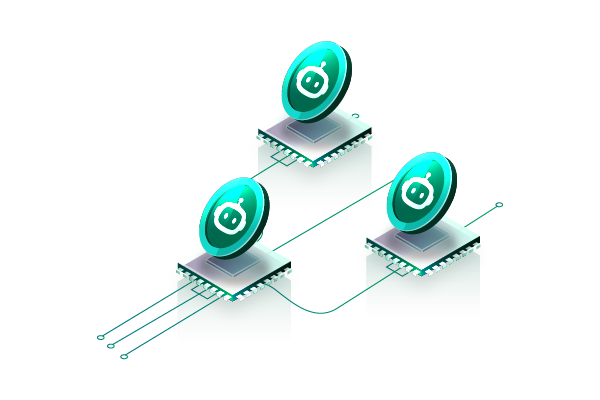
Not all tokenized agents are built the same. Some are simple and use rules while others are highly independent and learn over time. The table below shows the types of agents in Web3 today.
Table 1. Comparison of AI Agents’ Types
| Agent Type | Reasoning Method | Web3 Example |
| Simple Reflex | Uses strict “if-then” rules without memory. | Liquidation bot executing hardcoded stop-losses. |
| Model-Based | Relies on internal memory of past states. | Compliance bot analyzing 24-hour transaction patterns. |
| Goal-Based | Evaluates multiple paths to hit a target. | Arbitrage bot finding the cheapest DEX routing. |
| Utility-Based | Weighs trade-offs to maximize outcomes. | Yield farmer balancing gas fees against returns. |
| Learning | Improves decision logic via feedback loops. | Trading algorithm refining its strategy post-trade. |
How Does a Tokenized AI Agent Work?
The architecture behind a tokenized AI agent requires a seamless bridge between off-chain artificial intelligence computations and on-chain financial execution. Blockchains are secure and transparent ledgers, but they are too slow and expensive to host heavy machine learning processes directly. Therefore, tokenized agents rely on a highly orchestrated hybrid model.
Off-Chain Computation
The hard work of the system happens outside of the main system. The AI agent does its job on computer networks that are not controlled by one person or on big cloud servers. It uses LLMs or special computer programs that can learn and do things on their own to get the job done. It constantly monitors off-chain data feeds, market prices, or user inputs to determine its next optimal move without bogging down the blockchain.
The Agent Wallet and Identity
Every tokenized AI agent is assigned a dedicated cryptocurrency wallet. This is what makes a tokenized AI agent differ from others. The tokenized AI agents will have identity in the digital world and a wallet to make transactions through smart contract standards or native blockchain architecture. This will help them to autonomously decide and process financial transactions in the market.
Smart Contract Execution
After an off-chain AI makes a decision, then it will affect the blockchain. For instance, you have an AI agent that’s in charge of a decentralized finance portfolio. This AI agent might think it is an idea to trade tokens because the market is changing. The AI agent uses its wallet to sign the transaction. It pays for the network fees using the money it has. Then it uses a smart contract to complete the trade.
Tokenized Ownership and Governance
The agent’s existence and economic output are tied to a specific token. The creators of the AI can issue these tokens to the public during a launch phase. If you hold the agent’s token, you might receive a percentage of the transaction fees the agent earns. You may also get voting rights to decide whether the agent should be upgraded to a newer AI model, altering its underlying code and behavior.
Also Read: AI Agent Architecture: Components, Patterns, and How It Works
What Are the Key Components of a Tokenized AI Ecosystem?

To fully grasp the mechanics of tokenized AI agents, it is important to understand the infrastructure that makes them possible. The ecosystem relies on several interlocking technologies functioning in harmony.
- AI Agent Tokens: These are the specific cryptocurrencies or digital assets tied to the agent. These tokens can act as utility tokens, governance tokens, or yield-bearing tokens.
- Decentralized Oracles: Blockchains cannot get information from outside on their own. Oracles act like connections between the outside world and the blockchain. They take information that’s not on the blockchain, like what the stock prices are, and they put this information into the blockchain. This feature helps the AI agent make decisions based on what is happening in the real world.
- Agentic Payment Frameworks: Traditional credit card networks were not built for autonomous software. In recent years, frameworks have emerged that issue scoped, single-use, mathematically verifiable payment credentials, allowing an agent to spend money within strict limits set by its human owner.
- Decentralized Compute Networks: Instead of relying on centralized cloud providers, many tokenized AI agents source their processing power from decentralized peer-to-peer networks, paying for server space dynamically with crypto.
What Are the Examples of Tokenized AI Agents?
To truly understand how this technology works, we must look at the projects actively deploying these autonomous systems today. Here are three primary examples of tokenized AI agents and the infrastructure powering them.
1. HeLaSyn (by HeLa Labs)
HeLa Labs has pioneered one of the most advanced infrastructures for tokenized AI with its custom Layer-1 blockchain, actively positioning itself as the “Home Chain for AI Citizens.” At the absolute core of this ecosystem is HeLaSyn, their dedicated agent runtime environment.
Unlike other legacy blockchain networks, HeLaSyn treats AI agents as first-class citizens. When developers deploy an agent using the HeLaSyn runtime, the agent is automatically minted a soulbound NFT (known as a “Citizen ID”) and a natively integrated ERC-6551 wallet.
This means the agent instantly possesses a verifiable on-chain identity, its own treasury to hold digital funds, and a decentralized Memory Vault where its history and context live securely on-chain. Developers simply bring the AI logic, and HeLaSyn provides the autonomous infrastructure.
2. Autonolas (OLAS)
Autonolas is another prominent framework for building and deploying tokenized AI agents. The platform allows developers to create off-chain AI agents that interact seamlessly with on-chain smart contracts. A prime example of an Autonolas agent is a decentralized oracle agent.
Instead of relying on a single centralized data provider, a swarm of tokenized agents fetch real-world data, reach a consensus among themselves, and post the verified data on-chain. The agents hold their own wallets, pay their own gas fees, and earn OLAS tokens as a reward.
The OLAS token ecosystem aligns the incentives of the developers who build the agents, the operators who run the compute nodes, and the users who rely on the automated services.
3. Virtuals Protocol
Moving into the realms of entertainment, gaming, and the metaverse, Virtuals Protocol provides a fascinating example of consumer-facing tokenized agents. They allow creators to launch tokenized AI avatars and NPCs (Non-Player Characters).
Through the protocol, the AI personality is tokenized, meaning users can buy shares of the agent. If an AI agent makes money, the profits go directly to the people who own tokens through automated agreements. This way groups of people can work together to support, control, and earn from a character. It helps connect two areas: community-based finance and the economy for creators.
Also Read: What is a Multi-Agent System in AI? A Guide to AI Agentic Teams
What Are the Core Benefits of a Tokenized AI Agent?

You might wonder why we need to add blockchain into the mix at all instead of relying on bank APIs. The answer lies in the unique advantages that decentralized, permissionless ledgers provide to autonomous systems:
- Transparent and Verifiable Activity: Every financial transaction, data retrieval, and contract execution is recorded on an immutable public ledger, creating perfect audit trails for high-stakes industries like finance and logistics.
- Fractional Ownership and Crowdfunding: Tokenization democratizes AI development by allowing creators to crowdfund specialized agents, giving the community fractional ownership and a direct share in the profits.
- Autonomous Machine-to-Machine Economies: Tokenized AI agents can seamlessly hire and pay other specialized agents for data or services using micro-transactions, enabling a frictionless, 24/7 automated global economy.
- Aligned Incentives and Decentralized Governance: Rather than being controlled by a centralized corporate board, a tokenized agent is governed by a Decentralized Autonomous Organization (DAO) where token holders vote on ethical guidelines and strategic pivots.
What Are the Challenges of a Tokenized AI Agent?
To someone that wants to answer the question “what is a tokenized AI agent?” they need to know its flaws and challenges. The following paragraphs will explain the risks of using and implementing tokenized AI agents:
- Security and Smart Contract Vulnerabilities: Giving an AI agent programmatic access to digital funds creates a massive target for hackers; robust security auditing, multi-signature requirements, and fail-safe kill switches are absolutely mandatory to prevent drained wallets.
- Regulatory and Legal Uncertainty: If an agent distributes profits to token holders, those tokens risk being classified as unregistered securities by regulators, and the legal liability for autonomous financial crimes remains a completely unresolved gray area.
- Scalability and Gas Fees: Because every on-chain action requires a transaction fee, the profitability of high-frequency agents can be quickly eroded, making high-throughput Layer-2 scaling solutions essential for long-term viability.
- The Outlook for Decentralized Automation: Despite these hurdles, the trajectory is clear, we are rapidly moving toward a future where human workflows are seamlessly augmented by a sovereign, decentralized workforce of tokenized agents.
Final Thoughts
The whole digital world is changing in a way. When someone asks, “What is a tokenized AI agent?” you start to see a future where AI is not just stuck in chat boxes and big company servers. Because of how powerful blockchain and tokenization are, artificial intelligence systems are becoming autonomous processes for transactions with money; they have identities that can be checked on the internet, and people in the community help make decisions.
Tokenized AI agents do things like trade money, manage virtual worlds, check the data, and make supply chains simpler. By letting more people own things and making sure everything is fair and cannot be changed, this technology is going to open up ways of doing business that will change the internet for the next generation. Tokenized AI agents are really making a difference. The idea of AI agents is helping to create a new world where AI agents autonomously do their things.
Frequently Asked Questions
What is the main difference between a regular AI agent and a tokenized AI agent?
While a regular AI agent is controlled by a centralized company, a tokenized AI agent operates autonomously on a blockchain.
How do tokenized AI agents make money?
They generate revenue by autonomously providing valuable services and store these profits in their wallets to distribute among token holders.
Are AI agent tokens considered safe investments?
They are considered high-risk investments because their value depends entirely on the agent’s utility within a volatile market.
Can a tokenized AI agent operate entirely without human intervention?
Yes, a tokenized AI agent can continuously monitor its environment and trigger on-chain smart contracts autonomously, though most developers implement strict spend limits to prevent errors.
How do you stop a tokenized AI agent if it malfunctions?
If developers included a decentralized kill switch in its smart contracts, a security council or token holders could vote to freeze the agent’s wallet and halt its operations.
Do tokenized AI agents have legal rights?
Even though they possess digital identities and manage funds autonomously, tokenized AI agents are not legally recognized as entities, leaving liability with the developers or the governing DAO.

Tegar Rahman Hidayah is an SEO content writer specializing in technology and financial markets, with a strong emphasis on blockchain, cryptocurrency, and fintech. Passionate about bridging innovation and understanding, he aims to make advanced concepts more approachable through clear and informative storytelling. His work frequently explores emerging trends in web3, blockchain, and data-driven technologies, helping readers navigate the rapidly evolving landscape of modern finance.